


Turkish Labor Law in Antalya: Essential Rights for Foreign Workers & Expats

Foreign nationals working in Antalya are generally entitled to the same fundamental employment protections as Turkish employees. Turkish labor legislation regulates how employers must pay salaries, organize working hours, provide annual leave, register employees with social security and handle dismissals. Foreign workers must also comply with immigration and work permit requirements. Understanding how these rules work together can help expatriates avoid employment problems and make informed decisions when accepting or leaving a job in Türkiye.

Understanding Employment Rights in Antalya as a Foreign Worker
Antalya attracts people from different parts of the world. Some move there permanently, others establish businesses, and many accept employment in the city's tourism, hospitality, construction, healthcare, education and property sectors.
For an expatriate, starting a new job in Türkiye often involves more than agreeing on a salary. There may be questions about work permits, employment contracts, accommodation, social security contributions, working hours and the consequences of leaving a job.
These questions become particularly important in Antalya's tourism industry, where seasonal employment, rotating shifts and employer-provided accommodation are common.
Turkish employment legislation does not generally provide a separate, lower level of workplace protection simply because an employee holds a foreign passport. However, foreign nationals must also consider the rules governing their right to work and reside in Türkiye.
The principal legislation includes:
Labor Law No. 4857 (İş Kanunu): Regulates employment contracts, working hours, wages, annual leave and termination.
International Labor Force Law No. 6735 (Uluslararası İşgücü Kanunu): Establishes the framework for employing foreign nationals and obtaining work authorization.
Social Insurance and General Health Insurance Law No. 5510: Regulates social security obligations and insurance benefits.
Occupational Health and Safety Law No. 6331: Establishes workplace health and safety responsibilities.
Labor Courts Law No. 7036: Regulates labor court proceedings and mandatory mediation.
The legislation can be consulted through the Ministry of Labor and Social Security, the Ministry of Justice legislation database and the Official Gazette of the Republic of Türkiye.
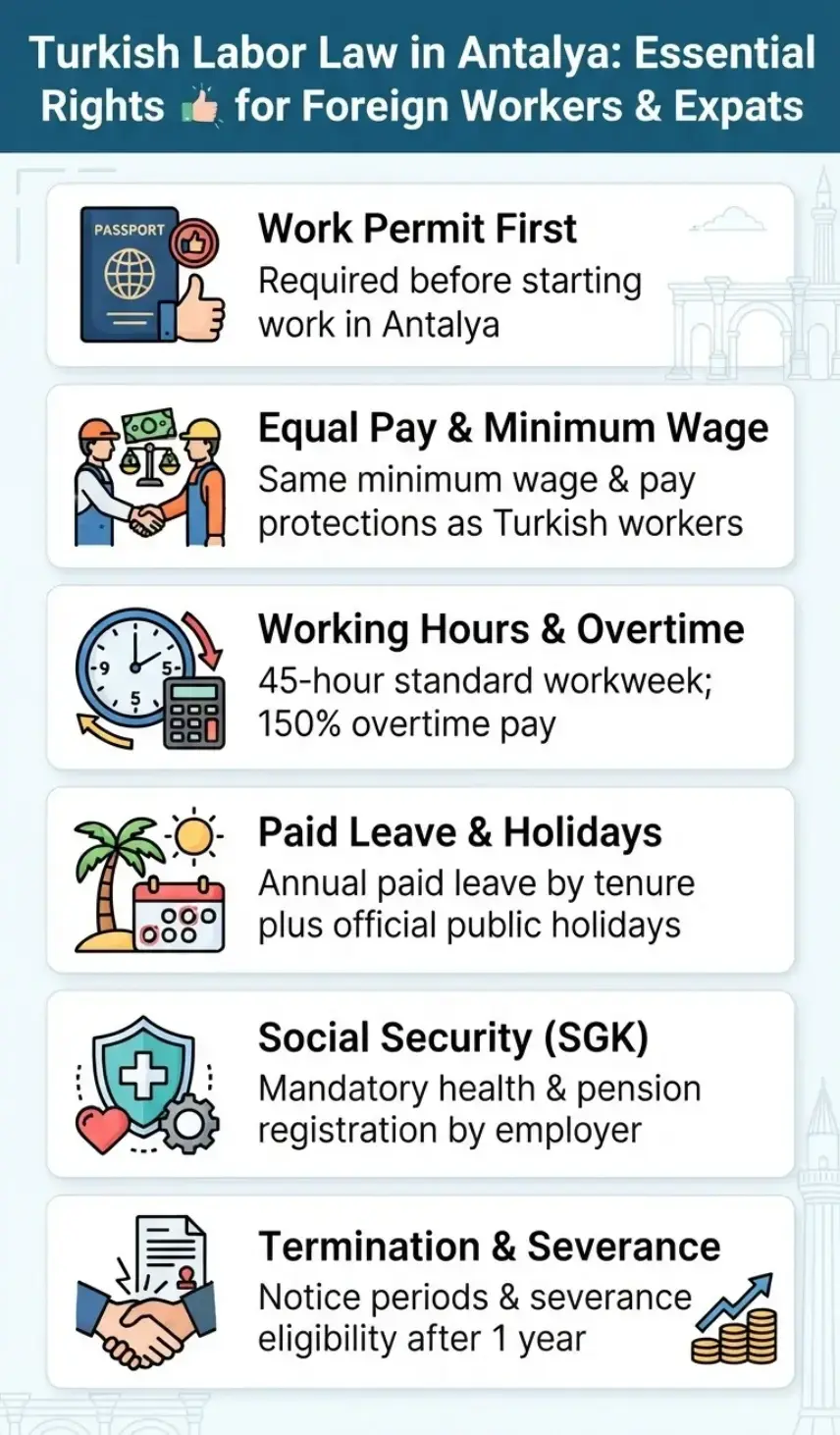
1. Do Foreign Workers Have the Same Employment Rights as Turkish Citizens?
Generally, yes.
A foreign national who is legally employed in Türkiye is protected by the applicable Turkish employment legislation. An employer cannot simply disregard statutory employment obligations because an employee is from another country.
For example, a foreign receptionist working at a hotel in Lara, a restaurant employee in Konyaaltı or a construction worker in Belek may have statutory rights concerning wages, working hours, weekly rest, annual leave and occupational safety.
Depending on the circumstances, employment protections may include:
Payment of agreed wages.
Protection under the applicable minimum wage rules.
Overtime compensation.
Weekly rest periods.
Paid annual leave.
National and public holiday entitlements.
Social security registration.
Protection against unlawful discrimination.
Severance and notice compensation where statutory conditions are met.
Access to employment dispute resolution procedures.
Does nationality affect employment protection?
Nationality can affect whether a person needs a work permit, whether a particular occupation is restricted and whether a statutory exemption applies.
However, nationality alone does not generally remove the employment rights available under Turkish law.
Consider an expatriate who has worked at the same Antalya hotel for several years. If the employer refuses to pay earned overtime or outstanding wages, the employee's foreign nationality does not automatically prevent them from pursuing the relevant employment entitlements.
There is, however, an important distinction between immigration compliance and employment protection. A person who works without the necessary authorization may face immigration and administrative consequences. That issue should be assessed separately from any unpaid employment entitlements.
Which employees are covered by Labor Law No. 4857?
Labor Law No. 4857 generally applies to employees working under employment contracts within its scope.
Article 4 identifies certain exceptions, including specified agricultural and forestry activities, domestic services and other legally defined categories.
The actual nature of the work matters. An employer cannot necessarily avoid employment legislation simply by describing an employee as a freelancer, consultant or independent contractor.
Where the individual works under the employer's direction, performs assigned duties and receives remuneration within an employment relationship, the legal classification should be examined carefully.
2. Work Permits for Foreign Employees in Antalya
Before accepting employment, a foreign national should establish whether a work permit or work permit exemption is required.
Under Article 6 of International Labor Force Law No. 6735, foreign nationals covered by the legislation generally cannot work in Türkiye without the required authorization.
A residence permit and a work permit serve different purposes. Having permission to stay in Türkiye does not automatically mean that a person can accept employment.
The Ministry of Labor's official work permit guidance explains the relevant requirements.
Is a residence permit sufficient to work in Antalya?
No, not ordinarily.
A standard residence permit does not automatically grant employment rights.
For example:
A foreign national living in Antalya on a tourist residence permit cannot automatically start working at a hotel.
Owning an apartment in Türkiye does not, by itself, authorize the owner to work.
A family residence permit does not automatically provide unrestricted employment rights.
International students must comply with the specific employment rules applicable to their status.
There are statutory exceptions, including certain categories of foreign nationals who may work without obtaining an ordinary work permit.
These include qualifying Blue Card holders and certain individuals covered by international protection or other specific legal arrangements.
The relevant status must be verified rather than assumed.
How can a foreign national apply for a work permit?
There are generally two application routes.
A. Applying from within Türkiye
A foreign national who holds a qualifying residence permit issued for at least six months and which remains valid on the application date may generally have their prospective employer submit a domestic work permit application.
Applications are processed through the Ministry's electronic system.
The employer must provide the necessary information and supporting documents, including the relevant employment details.
B. Applying from outside Türkiye
An application from abroad generally involves two stages:
The foreign national applies personally at the relevant Turkish embassy or consulate in their country of citizenship or lawful residence.
The diplomatic mission provides a reference number, which the employer in Türkiye uses to complete the corresponding application through the Ministry's electronic system.
The official e-İzin work permit system provides access to the application process.
How long does a Turkish work permit application take?
The Ministry states that duly completed work permit applications are generally evaluated within 30 days, provided that the necessary information and documents are complete.
If additional information or documentation is requested, the relevant 30-day evaluation period runs from the date the requested material is uploaded and the application is completed.
This should not be interpreted as a guarantee that every application will be approved within 30 days.
The outcome depends on the applicable assessment criteria and the circumstances of the application.
What types of work permits are available?
The principal categories include:
Type | General position |
Fixed-term work permit | Generally granted for up to one year for the first application, subject to the employment arrangement |
First extension | May be granted for up to two years with the same employer |
Subsequent extension | May be granted for up to three years with the same employer |
Permanent work permit | May be available to qualifying foreign nationals under statutory conditions |
Independent work permit | Allows qualifying foreign nationals to work on their own behalf |
Work permit exemption | Applies to specified categories under the relevant legislation |
These periods are subject to the applicable statutory requirements and Ministry assessment.
Further details are available from the Directorate General of International Labour Force.
Can a foreign employee change employers?
Yes, but the employee must first consider the work permit implications.
An ordinary employer-specific work permit does not automatically authorize employment with another unrelated company.
For example, a foreign national employed by a hotel in Belek cannot simply use the same employer-specific permit to begin working at a separate hotel in Side.
A new work permit application will generally be necessary.
The employee should establish the correct procedure before commencing the new employment relationship.
What happens if someone works without a valid work permit?
Working without the required authorization can result in administrative fines for both the foreign employee and the employer.
The foreign national may also be reported to the relevant immigration authorities for further action, including possible removal proceedings.
However, it is important not to confuse the consequences of unauthorized employment with the question of whether wages or other employment entitlements have accrued.
These are separate legal issues and must be assessed accordingly.
3. Minimum Wage and Salary Rights in Antalya
Salary is often one of the first matters discussed when a foreign national accepts a job in Antalya.
An employee should understand whether the agreed amount is gross or net, when payment is due and whether accommodation, meals or other benefits form part of the remuneration package.
Turkish minimum wage legislation generally protects foreign employees in the same way as Turkish employees covered by the applicable rules.
An employer cannot lawfully justify paying below the applicable minimum simply because the employee is unfamiliar with Turkish law.
What is the minimum wage in Türkiye in 2026?
The Ministry of Labor and Social Security publishes the following minimum wage figures for the period from 1 January to 31 December 2026:
Wage category | Monthly amount |
Gross minimum wage | TRY 33,030 |
Net minimum wage | TRY 28,075.50 |
The gross figure is particularly important when examining payroll calculations, social security contributions and statutory employment entitlements.
The net amount represents the published standard take-home calculation. Individual payroll circumstances and applicable deductions should still be considered.
Can foreign employees receive lower salaries than Turkish employees?
Differences in remuneration are not automatically unlawful. Employers may consider legitimate factors such as job responsibilities, qualifications, experience and contractual arrangements.
However, Article 5 of Labor Law No. 4857 establishes the principle of equal treatment and prohibits discrimination on specified grounds.
An employer should not use an employee's nationality or lack of familiarity with Turkish employment procedures as a reason to disregard applicable legal protections.
What if the employer pays salary in cash?
Cash payment is not automatically unlawful in every circumstance. Nevertheless, employers must comply with the applicable wage-payment, payroll, tax and social security requirements.
Employees should retain evidence of payments received.
Useful records include:
Employment agreements.
Bank transfer statements.
Pay slips.
Written salary agreements.
Messages discussing unpaid wages.
Records of deductions.
Relevant employer correspondence.
A verbal promise can be difficult to establish when a dispute arises months later. Written records make the employment arrangement easier to examine.
Can an employer make deductions from salary?
Deductions must have a lawful basis.
Article 38 of Labor Law No. 4857 regulates disciplinary wage deductions. An employer cannot simply withhold several days of salary as punishment without complying with the statutory requirements.
Foreign employees should ask for an explanation of any unexpected deduction and retain the relevant payroll records.
4. Working Hours, Overtime and Rest Breaks
Long shifts are familiar to many people working in Antalya's tourism and hospitality industries.
Hotel employees may work early mornings, late evenings, weekends and public holidays. Restaurants may operate split shifts, while construction employees may follow different daily schedules.
These arrangements do not remove the employer's obligation to comply with Turkish working-time legislation.
What is the normal weekly working limit?
Under Article 63 of Labor Law No. 4857, normal working time is generally limited to 45 hours per week.
The weekly working period can be distributed differently across working days, subject to statutory restrictions.
The ordinary daily working period must generally not exceed 11 hours.
For example, a hotel may arrange different shifts throughout the week, provided that the relevant working-time rules are respected.
How is overtime calculated?
Article 41 distinguishes between statutory overtime and work exceeding a lower contractual working-time limit.
Type of work | Additional payment |
Work exceeding 45 hours per week | 50% above the normal hourly wage |
Work exceeding a lower contractual weekly limit but not 45 hours | 25% above the normal hourly wage |
For example, if an employment agreement establishes a 40-hour working week, work between 40 and 45 hours is generally treated as fazla sürelerle çalışma, rather than statutory overtime.
This distinction matters because the additional payment is different.
Can an employee take time off instead of receiving overtime pay?
Yes, where the statutory conditions are satisfied.
An employee may choose equivalent free time instead of the additional overtime payment.
The statutory conversion is:
One hour of overtime provides 1 hour and 30 minutes of free time.
One hour of work exceeding a lower contractual limit but remaining within 45 hours provides 1 hour and 15 minutes of free time.
The employee must use this free time within the period prescribed by law.
Is there an annual overtime limit?
Generally, overtime cannot exceed 270 hours per employee in a year.
The statutory consent requirements and restrictions on overtime must also be respected.
An employer cannot assume that a worker's willingness to accept a job at a busy hotel means that unlimited overtime is permitted.
Are meal breaks included in working hours?
Generally, statutory rest breaks are not counted as actual working time.
Article 68 of Labor Law No. 4857 provides the following minimum break periods:
Daily working period | Minimum break |
Up to 4 hours | 15 minutes |
More than 4 hours and up to 7.5 hours | 30 minutes |
More than 7.5 hours | 60 minutes |
For example, if an employee works from 09:00 to 18:00 and receives a one-hour unpaid meal break, the actual working time is generally eight hours.
Do employees have to work on Saturdays and Sundays?
Turkish law does not require every employee to have Saturday and Sunday off.
Businesses such as hotels and restaurants operate throughout the week. Employers may therefore arrange weekly rest on different days.
However, Article 46 of Labor Law No. 4857 generally requires at least 24 consecutive hours of weekly rest, subject to the applicable statutory conditions.
What happens when an employee works on a public holiday?
Articles 44 and 47 regulate work on national holidays and general holidays.
An employee who does not work on an applicable public holiday is generally entitled to the holiday wage.
If the employee works on that day, an additional day's wage is payable for the work performed under the statutory calculation.
This entitlement is not removed simply because the employee is a foreign national or works in the tourism industry.
Official information about working life and employment regulations is available through the Ministry of Labor's Directorate General of Labor.
5. Annual Paid Leave for Foreign Workers
Annual leave is particularly important for expatriates who have moved to Antalya for longer-term employment.
It gives employees an opportunity to take time away from work without losing their statutory wage entitlement.
Under Article 53 of Labor Law No. 4857, employees who have completed at least one year of service, including the probationary period, are generally entitled to paid annual leave.
How many days of annual leave are available?
The statutory minimum entitlements are:
Length of service | Minimum annual leave |
1–5 years, including 5 years | 14 days |
More than 5 years but less than 15 years | 20 days |
15 years or more | 26 days |
Employees under 18 and employees aged 50 or above are entitled to at least 20 days of annual paid leave.
An employment agreement or collective labor agreement may provide more favorable leave arrangements.
Can an employer refuse annual leave because an employee is foreign?
No. Nationality alone is not a lawful reason to deny statutory annual leave.
Employers may organize leave dates according to workplace requirements and applicable legislation. However, they cannot simply remove an employee's accrued entitlement.
What happens to unused annual leave when employment ends?
Unused accrued annual leave does not automatically disappear when employment terminates.
Under Article 59 of Labor Law No. 4857, outstanding annual leave is converted into a monetary entitlement when the employment contract ends.
The calculation is generally based on the employee's wage applicable on the termination date.
This is particularly relevant for seasonal employees who finish their work at the end of a tourism season or expatriates who decide to leave Türkiye.
6. Employment Contracts: What Should Expats Check Before Signing?
An employment agreement is more than a document confirming that someone has been hired.
It establishes the terms of the employment relationship and can become important evidence if a disagreement arises later.
Foreign workers should take the time to understand what they are agreeing to, particularly when the contract is written in Turkish and they are not comfortable reading the language.
Is a written employment contract compulsory?
Article 8 of Labor Law No. 4857 establishes the general rules.
A written agreement is not compulsory for every ordinary employment relationship. However, employment contracts lasting one year or longer must generally be made in writing.
Where a written contract is not made, the employer must provide a written document containing essential employment information within the statutory period, subject to the relevant exceptions.
For foreign employees, written documentation is especially important because it may also form part of the work permit application.
What should an employment contract contain?
Before signing, employees should understand:
The full legal names of the employer and employee.
The job title and actual responsibilities.
The workplace address.
The agreed gross salary.
Payment dates and payment arrangements.
Working hours and shift arrangements.
Overtime conditions.
Weekly rest periods.
Annual leave entitlements.
The duration of the contract.
Probationary provisions.
Notice and termination conditions.
Accommodation, meals and other benefits, where applicable.
An expatriate should be particularly careful about signing an agreement that differs from the terms previously discussed.
What should seasonal employees in Antalya understand?
Seasonal employment is common in Antalya, particularly in hotels, restaurants and tourism businesses.
Some employees are recruited for a specific season, while others work under ongoing employment arrangements with seasonal variations.
Article 11 of Labor Law No. 4857 regulates fixed-term employment contracts.
A fixed-term contract generally requires an objective justification, such as completion of a particular project, the occurrence of a specific event or work for a defined period.
Simply labelling a contract as seasonal does not automatically make it a valid fixed-term agreement.
Repeated fixed-term contracts without the required objective justification may be treated as an indefinite-term employment relationship under the statutory rules.
This can affect the employee's legal position when the employer ends the relationship.
Should foreign employees sign contracts they cannot understand?
It is sensible to obtain an accurate translation before signing an agreement written in a language the employee does not understand.
This is particularly important where the agreement contains provisions concerning:
Salary deductions.
Accommodation charges.
Working hours.
Overtime.
Early termination.
Confidentiality.
Non-competition.
Repayment obligations.
An employee should not rely solely on an informal verbal explanation of the contract.
7. Social Security and SGK Rights of Foreign Employees
Social security registration is another important part of lawful employment in Türkiye.
The Social Insurance and General Health Insurance Law No. 5510 establishes the principal framework for social security contributions and insurance benefits.
The Social Security Institution, commonly known as SGK, administers the relevant system.
Must employers register foreign employees with SGK?
Generally, yes, where Turkish social security legislation applies.
The fact that an employee holds a work permit does not remove the employer's social security responsibilities.
International Labor Force Law No. 6735 and the applicable social security legislation establish obligations concerning the registration of foreign employees.
The Ministry explains the relevant requirements in its official work permit guidance.
What benefits may an SGK-registered foreign employee receive?
Depending on the applicable insurance status and qualifying conditions, benefits may include:
General health insurance.
Temporary incapacity benefits.
Occupational accident benefits.
Occupational disease benefits.
Maternity-related insurance benefits.
Invalidity benefits.
Old-age pension rights.
Survivors' benefits.
The exact entitlement depends on contribution records, insurance periods, statutory eligibility requirements and any applicable international agreement.
Can foreign employees receive a Turkish pension?
Yes, foreign nationals may acquire pension rights under Turkish social security legislation if they satisfy the relevant conditions.
Bilateral social security agreements may also affect how insurance periods are taken into account.
For example, an expatriate who previously worked in Germany, France, the Netherlands or another country should not assume that all previous insurance periods automatically transfer to Türkiye.
The relevant bilateral agreement and individual insurance history must be examined.
Information is available through the Social Security Institution (SGK) and the Ministry of Labor and Social Security.
How can employees check their SGK records?
Foreign employees with access to the relevant e-Government services can use the Turkish e-Government Gateway to check available social security records.
They should periodically review their employment and insurance information.
A work permit card alone does not establish that every employment period and contribution has been correctly declared.
8. Workplace Health and Safety Rights
Workplace safety is not just an employer's internal policy. It is a legal responsibility governed principally by Occupational Health and Safety Law No. 6331.
This is especially relevant in Antalya, where foreign nationals may work in hotels, kitchens, construction sites, maintenance departments, transport services and other workplaces involving physical or occupational risks.
What must employers provide?
Depending on the nature of the workplace and the applicable risk classification, employers have responsibilities concerning:
Workplace risk assessments.
Safety training.
Preventive measures.
Appropriate protective equipment.
Health surveillance where required.
Emergency arrangements.
Accident prevention.
Reporting and investigation of occupational accidents.
The Directorate General of Occupational Health and Safety provides official information about workplace safety requirements.
What if a foreign employee suffers a workplace accident?
An occupational accident can give rise to several legal consequences.
These may include social security benefits, medical treatment entitlements and potential employer liability, depending on the circumstances.
Employees should ensure that the incident is properly documented.
Useful evidence may include:
Hospital and medical records.
Accident reports.
Photographs of the location.
Witness information.
Employment and SGK records.
Relevant safety documentation.
Communications with the employer.
The legal assessment may involve Law No. 5510, Law No. 6331 and the relevant provisions of the Turkish Code of Obligations No. 6098.
Foreign nationality does not, by itself, remove the applicable workplace safety protections.
9. Discrimination and Harassment at Work
An employment problem is not always about money.
Foreign workers may sometimes experience unfair treatment, workplace harassment, discrimination or pressure connected with their immigration status.
Turkish legislation provides protections against specified forms of discrimination and unlawful workplace conduct.
What does Article 5 of Labor Law No. 4857 establish?
Article 5 regulates equal treatment in employment.
It prohibits discrimination on grounds including language, race, sex, political opinion, philosophical belief, religion and similar grounds, subject to the statutory framework.
The provision also addresses unequal treatment between employees performing comparable work.
Where an employer violates the principle of equal treatment, an affected employee may have a right to claim statutory compensation and other entitlements if the relevant conditions are established.
What if an employer threatens an employee with deportation?
A private employer does not independently have the authority to order a foreign employee's deportation.
Immigration decisions are matters for the competent public authorities and must follow the applicable legal procedures.
An employer should not use immigration threats to prevent an employee from raising legitimate concerns about unpaid wages or working conditions.
At the same time, foreign employees should take genuine work permit obligations seriously. Working without the necessary authorization can have immigration consequences.
Can foreign employees join trade unions?
Yes. Foreign employees working lawfully in Türkiye are not generally excluded from trade union membership merely because of their nationality.
The relevant legislation is Trade Unions and Collective Labor Agreements Law No. 6356.
The Ministry's official trade union information provides further information about the applicable framework.
10. Termination of Employment: What Happens When a Foreign Employee Is Dismissed?
Ending an employment relationship can be difficult for any employee. For an expatriate, the situation may be more complicated because employment, work authorization and residence arrangements can be connected.
Turkish law establishes rules governing notice periods, termination for just cause, severance compensation and other outstanding employment payments.
The legal consequences depend on the type of contract, length of service and reason for termination.
What notice period must an employer provide?
Article 17 of Labor Law No. 4857 establishes the general notice periods for indefinite-term employment contracts.
Length of service | Minimum notice |
Less than 6 months | 2 weeks |
6 months to less than 18 months | 4 weeks |
18 months to less than 3 years | 6 weeks |
3 years or more | 8 weeks |
These are statutory minimum periods.
An employer may pay notice compensation instead of allowing the employee to work through the notice period, where legally permitted.
Immediate termination may also be possible in circumstances recognized by law, including certain just-cause situations.
Can an employee resign without notice?
An employee working under an indefinite-term contract is generally expected to respect the applicable notice period.
However, Article 24 of Labor Law No. 4857 provides circumstances in which an employee may terminate the employment contract immediately for just cause.
These include specified health-related circumstances, conduct contrary to morality and good faith, and certain force majeure situations.
Persistent non-payment of wages may, depending on the facts and evidence, provide grounds for termination for just cause.
Not every workplace disagreement automatically qualifies.
An employee should establish the legal basis for termination before leaving the job, particularly where severance compensation may be involved.
What is severance pay in Türkiye?
Severance compensation, known as kıdem tazminatı, is principally governed by Article 14 of the former Labor Law No. 1475, which remains in force for this purpose.
Generally, an employee must have completed at least one year of service with the same employer and satisfy a legally recognized termination condition.
Qualifying circumstances may include:
Termination by the employer for reasons other than the statutory grounds that exclude severance.
Employee termination for a legally recognized just cause under Article 24 of Labor Law No. 4857.
Retirement-related circumstances satisfying the statutory requirements.
Certain military service circumstances.
Marriage-related termination by a female employee within the statutory one-year period following marriage.
Other statutory circumstances may also apply.
Severance compensation is generally calculated at 30 days' gross wage for each completed year of service, with proportional calculation for incomplete years and subject to the applicable statutory ceiling.
Certain regular benefits may also be included in the qualifying wage calculation.
Does every resignation create a right to severance?
No.
An employee who voluntarily resigns without a legally recognized qualifying reason does not automatically become entitled to severance compensation.
This distinction is important.
For example, an employee who decides to leave Antalya and return to their home country simply because they prefer to live elsewhere will not automatically qualify for severance pay.
The legal reason for termination must be examined.
Does leaving Türkiye affect an existing severance claim?
Leaving Türkiye does not, by itself, extinguish an accrued severance entitlement.
A foreign employee who has completed several years of employment at an Antalya hotel may still have a claim if the termination circumstances satisfy the statutory conditions.
The employee should retain employment records, salary evidence and termination correspondence.
What other payments may be due when employment ends?
Depending on the circumstances, the final employment settlement may include:
Outstanding wages.
Unpaid overtime.
Accrued unused annual leave.
Unpaid public holiday wages.
Severance compensation, where applicable.
Notice compensation, where applicable.
Other contractual or statutory payments.
An employer's final pay slip should not be treated as automatic proof that every employment obligation has been satisfied.
11. Unfair Dismissal and Reinstatement Rights
Turkish labor law provides job security protection to employees who satisfy specific statutory requirements.
Articles 18–21 of Labor Law No. 4857 establish the principal framework.
However, not every employee automatically qualifies for reinstatement protection.
Who can apply for reinstatement?
The statutory framework generally requires:
The employer must employ at least 30 employees.
The employee must have at least six months of service.
The employee must work under an indefinite-term employment contract.
The employee must not fall within an excluded category of employer representatives or other statutory exceptions.
Where these requirements are satisfied, the employer must have a valid reason for termination.
The reason may concern the employee's capacity or conduct, or the operational requirements of the workplace or establishment.
What if the employer dismisses an employee without a valid reason?
An eligible employee may challenge the dismissal through the mandatory mediation procedure.
The statutory time limits are important:
Procedural stage | General deadline |
Apply for mediation | Within one month of receiving the termination notice |
File a reinstatement claim after unsuccessful mediation | Within two weeks from preparation of the final mediation record |
These are short deadlines. Employees should not postpone examining their position.
What compensation may be awarded?
Where a court determines that the dismissal is invalid and the statutory conditions are satisfied, reinstatement may be ordered.
If the employer does not reinstate the employee within the statutory period following the employee's application, compensation of between four and eight months' wages may become payable.
The employee may also be entitled to up to four months of wages and other rights for the period of unemployment, subject to the applicable statutory conditions.
The relevant provisions are contained in Article 21 of Labor Law No. 4857.
A foreign employee must also consider whether reinstatement is compatible with their work permit status and whether any additional immigration steps are necessary.
12. What Can Foreign Workers Do If Their Employer Does Not Pay Them?
Unpaid wages are a common source of employment disputes in many industries.
An employee may discover that their salary has been delayed, overtime has not been paid or deductions have been made without a clear explanation.
The employer's failure to meet its obligations does not become lawful simply because the employee is foreign or has accepted seasonal employment.
What evidence should an employee keep?
A person considering an employment claim should preserve as much relevant evidence as possible.
Evidence | Its importance |
Employment agreement | Establishes the agreed terms |
Bank statements | Helps identify payments received |
Pay slips | Records declared salary and deductions |
Work schedules | Helps establish working hours |
Overtime records | Supports additional wage claims |
Emails and messages | May establish employer instructions or salary promises |
Witness details | May support the employee's account |
SGK records | Helps verify reported employment |
Employees should preserve original documents and avoid altering electronic evidence.
Can an employee complain to the Ministry?
Yes.
Employment-related concerns can be raised through the relevant Ministry channels.
The ALO 170 Labor and Social Security Communication Centre provides information and receives complaints concerning working life and social security.
An administrative complaint and a civil employment claim are different procedures. A complaint does not necessarily replace mandatory mediation or a court application.
Can a foreign worker claim unpaid wages after leaving Antalya?
Generally, yes, subject to the applicable limitation periods and procedural requirements.
Returning to another country does not automatically remove an employee's right to claim wages that have already become due.
However, the employee should consider how to preserve evidence, complete mediation procedures and receive formal legal notifications.
13. Employment Disputes in Antalya: Mediation and Labor Courts
Employment disputes in Türkiye follow a specific legal procedure.
Under Labor Courts Law No. 7036, mediation is a mandatory preliminary step for many employment claims.
This is important for expatriates who may assume that they can immediately file a lawsuit when an employer refuses to pay an outstanding amount.
Is mediation compulsory before filing an employment lawsuit?
Generally, yes.
Article 3 of Law No. 7036 requires an application to a mediator before bringing many employment-related claims to court.
These commonly include:
Unpaid wages.
Overtime compensation.
Annual leave payments.
Severance compensation.
Notice compensation.
Other employment-related receivables.
Reinstatement claims.
There are statutory exceptions, including certain occupational accident and occupational disease disputes.
The Ministry of Justice Mediation Department provides information about the mediation framework.
How does employment mediation work?
The process generally involves the following stages.
Step 1: Submit an application
The employee applies to the competent mediation office and identifies the employer and the employment dispute.
Step 2: Appointment of a mediator
A mediator is appointed in accordance with the applicable procedure.
Step 3: Discussion of the dispute
The parties discuss the outstanding matters. These may involve unpaid salary, overtime, annual leave, severance or reinstatement.
Step 4: Settlement or non-settlement
If an agreement is reached, the settlement terms are recorded in the final mediation documentation.
If the parties cannot reach an agreement, the mediator prepares the relevant final record.
Step 5: Court proceedings
Where mediation is unsuccessful, the employee may pursue the appropriate court proceedings, provided that the applicable procedural requirements and deadlines have been satisfied.
Which court handles employment disputes in Antalya?
Employment disputes generally fall within the jurisdiction of the competent Labor Court (İş Mahkemesi).
Where a Labor Court has not been established for the relevant judicial area, the competent Civil Court of First Instance may hear the matter under the applicable procedural rules.
Territorial jurisdiction must also be considered.
Article 6 of Law No. 7036 identifies the employee's workplace and the defendant employer's registered domicile among the principal jurisdictional connecting factors.
For example, an employee who works at a hotel in Antalya should not automatically assume that an employment dispute must be brought in Istanbul simply because the employer's head office is located there.
The legally relevant jurisdictional rules must be assessed according to the particular circumstances.
What is the limitation period for employment claims?
Different employment entitlements are subject to different limitation rules.
The following table provides a general overview:
Employment claim | General limitation period |
Unpaid wages | 5 years |
Overtime compensation | 5 years |
Unused annual leave payment following termination | 5 years |
Severance compensation | 5 years |
Notice compensation | 5 years |
Article 32 of Labor Law No. 4857 establishes a five-year limitation period for wage claims.
Other claims must be examined under their applicable statutory provisions, including Law No. 6098 on the Turkish Code of Obligations and the relevant amendments.
The starting point depends on when the particular entitlement becomes due.
Mandatory mediation also affects the calculation of limitation periods and certain procedural deadlines.
An expatriate should therefore avoid postponing action simply because they have returned to their home country.
14. What Happens to an Expat's Residence Status After Losing a Job?
For many foreign employees, this is one of the most pressing questions.
Someone who has moved to Antalya for employment may have arranged accommodation, family life and other personal commitments around their work permit.
When employment ends, they may understandably be concerned about whether they can remain in Türkiye.
Under Article 27 of Law No. 6458 on Foreigners and International Protection, a valid work permit or work permit exemption generally serves as a residence permit during its validity, subject to statutory exceptions.
However, the end of employment can affect the underlying work authorization.
What happens when a work permit is terminated?
Employers and relevant work permit holders must comply with the notification obligations established under Article 22 of Law No. 6735.
The Ministry generally must be notified within 15 days of the commencement or termination of work under the permit or exemption and of circumstances requiring cancellation.
The former employee should establish:
Whether the work permit has been terminated or cancelled.
Whether another lawful residence basis is available.
Whether a prospective employer can submit a new work permit application.
Whether a separate residence permit application is necessary.
Whether the change affects the employee's lawful stay.
The Presidency of Migration Management provides official information about residence permits and immigration procedures.
Can an expatriate move to another employer?
Yes, provided the necessary work authorization is obtained.
A new employer must comply with the applicable application requirements.
The employee should establish the correct procedure before beginning the new job rather than assuming that an existing permit automatically transfers.
Does losing employment automatically mean deportation?
No.
Termination of employment and deportation are separate legal matters.
Immigration authorities must assess the individual's circumstances under Law No. 6458 and the applicable regulations.
A former employee should neither assume that they must immediately leave Türkiye nor assume that their previous work permit will continue to provide residence rights indefinitely.
15. Employment Issues Particularly Relevant to Antalya
Turkish employment legislation applies nationally, but the nature of employment in Antalya creates practical considerations that foreign workers should understand.
Seasonal employment in the tourism industry
Tourism is an important part of Antalya's economy.
Foreign employees may find work in areas such as:
Lara.
Belek.
Kemer.
Side.
Alanya.
Konyaaltı.
Manavgat.
Hotels and other tourism businesses may recruit foreign nationals for seasonal positions.
Employees should understand whether their contracts are genuinely fixed-term or whether they form part of an ongoing employment relationship.
The end of a tourism season does not automatically remove every employment entitlement.
The legal consequences depend on the actual contract and circumstances.
Accommodation and meals provided by employers
Some hotels provide staff accommodation, meals or transport.
These arrangements should be clearly explained before the employee starts work.
It is worth checking whether accommodation and meals are:
Additional benefits.
Included in the remuneration package.
Subject to specific contractual conditions.
Relevant to the calculation of employment entitlements.
An employer cannot simply deduct arbitrary accommodation or meal charges from an employee's wages.
Any deduction must have a lawful basis.
Foreign employees in construction and real estate
Antalya also has employment opportunities in construction, architecture, engineering and property-related businesses.
Employees working on construction sites must receive the workplace safety protections required by Law No. 6331.
Foreign professionals in regulated occupations may also need to comply with qualification recognition, professional licensing and other legal requirements.
An employment contract alone does not authorize a foreign national to practice a profession for which separate permission is required.
The Vocational Qualifications Authority and relevant professional institutions provide information about professional qualification requirements.
Foreign managers and business owners
Some expatriates establish companies or acquire shares in Turkish businesses.
However, being a shareholder or company director does not automatically resolve the work permit question.
The relevant rules depend on the individual's actual role, professional activities, company structure and applicable statutory exemptions.
Foreign investors should distinguish between owning shares in a company and personally performing work in Türkiye.
16. A Practical Checklist Before Accepting Employment in Antalya
Before starting a new job, it is sensible to take a little time to check the essential arrangements.
This can help avoid misunderstandings that may otherwise become difficult to resolve.
Employment and immigration checklist
Confirm that the employer is a properly registered business.
Establish whether a work permit or exemption is required.
Confirm that the permit covers the intended employment.
Obtain a written employment agreement where required.
Check whether the contract is fixed-term or indefinite-term.
Understand the agreed gross salary.
Check the applicable minimum wage.
Confirm the working schedule and weekly rest arrangements.
Understand how overtime is calculated.
Check annual leave and public holiday entitlements.
Confirm the employer's SGK registration obligations.
Clarify accommodation, meal and transport arrangements.
Understand workplace safety arrangements.
Keep copies of employment and payment records.
Review notice and termination provisions.
Understand how ending employment may affect residence status.
This checklist is relevant to expatriates accepting employment in hotels, restaurants, construction companies and other businesses throughout Antalya.
17. How Kurucuk & Associates Approaches Turkish Employment Law Matters
Employment issues involving foreign nationals can involve more than one area of Turkish law.
A disagreement over salary, for example, may also raise questions about the employment contract, work permit conditions, SGK registration and the procedure for resolving an employment dispute.
Kurucuk & Associates is an Istanbul-based Turkish law firm providing legal services in Turkish law matters, including employment-related issues involving foreign nationals and international businesses.
Although the firm is based in Istanbul, Turkish employment legislation applies nationally. Employment relationships in Antalya are therefore assessed under the same principal statutory framework.
Depending on the circumstances, employment-related legal matters may involve:
Employment contracts and contractual obligations.
Work permits and foreign employee status.
Unpaid salary and overtime claims.
Severance and notice compensation.
Annual leave and public holiday entitlements.
Social security registration.
Workplace accidents and occupational safety.
Termination and reinstatement disputes.
Mandatory mediation and labor court proceedings.
The appropriate legal assessment depends on the actual employment agreement, work permit documentation, payroll records and circumstances surrounding the dispute.
Further information about the firm's employment-related legal services is available on its Employment Lawyer in Turkey page.
Information about the firm's lawyers is available through the Kurucuk & Associates legal team.
For information about the firm's managing partner and English-language legal services, see Av. Mehmet Özgür Kurucuk.
18. Frequently Asked Questions About Turkish Labor Law in Antalya
1. Do foreign workers have the same employment rights as Turkish citizens in Antalya?
Generally, yes. Foreign employees covered by Turkish labor legislation have statutory protections concerning wages, working hours, annual leave, overtime, social security and workplace safety. They must also satisfy the applicable work authorization requirements.
2. Can I work in Antalya with a tourist residence permit?
No. A standard tourist residence permit does not automatically provide permission to work. Most foreign nationals must obtain a valid work permit or qualify for a statutory work permit exemption before starting employment.
3. What is the minimum wage in Türkiye in 2026?
The gross monthly minimum wage is TRY 33,030, while the published net monthly minimum wage is TRY 28,075.50 for the period from 1 January to 31 December 2026.
4. Can an Antalya hotel employ foreign workers without a work permit?
Generally, no. Foreign nationals covered by International Labor Force Law No. 6735 must obtain the necessary work authorization before beginning employment. Both the employer and employee may face administrative consequences for unauthorized employment.
5. Can a foreign employee claim unpaid overtime in Antalya?
Yes, where the employee is covered by the applicable legislation and can establish the relevant working hours. Statutory overtime exceeding 45 hours per week is generally paid at 150% of the normal hourly wage.
6. How much annual leave does a foreign employee receive in Türkiye?
After completing one year of service, the statutory minimum is generally 14 days for employees with up to five years of service, 20 days for employees with more than five but less than 15 years, and 26 days for employees with 15 years or more. Employees under 18 and those aged 50 or above are entitled to at least 20 days.
7. Can I receive severance pay if I resign from my job in Antalya?
Possibly, but not every resignation creates a severance entitlement. The employee must satisfy the statutory service requirement and a legally recognized qualifying termination condition.
8. Can my employer dismiss me without notice?
An employer generally has to respect the applicable notice period for an indefinite-term contract unless a statutory exception, such as just-cause termination, applies. Alternatively, notice compensation may be payable where legally permitted.
9. Can I challenge an unfair dismissal in Türkiye?
Potentially. Employees who satisfy the job security requirements under Articles 18–21 of Labor Law No. 4857 may challenge an invalid dismissal through mandatory mediation and subsequent court proceedings.
10. Can I sue my employer in Antalya if I am a foreign national?
Yes. Foreign nationality does not generally prevent an employee from bringing an employment claim before the competent Turkish court. The applicable jurisdictional rules, mediation requirements and procedural deadlines must be respected.
11. What happens to my residence permit if I lose my job?
A valid work permit generally also serves as a residence permit during its validity. However, termination or cancellation can affect the employee's right to remain in Türkiye under that authorization. Another lawful residence basis may need to be established.
12. Can I claim unpaid wages after returning to my home country?
Generally, yes. Leaving Türkiye does not automatically extinguish accrued wage claims. The employee must nevertheless comply with applicable limitation periods and procedural requirements, including mandatory mediation where required.
13. Can an employer refuse to pay unused annual leave when I leave Türkiye?
No, where accrued and unused statutory annual leave remains payable. Under Article 59 of Labor Law No. 4857, outstanding annual leave is converted into a monetary entitlement when the employment contract ends.
14. Can I change hotels or employers while holding a Turkish work permit?
A foreign employee with an employer-specific work permit generally needs a new work permit to work for another employer. The employee should establish the relevant application procedure before starting the new employment.
15. Can seasonal workers claim employment rights?
Yes. Seasonal employment does not automatically remove statutory employment protections. The applicable rights depend on the employment relationship, contract type and relevant legal provisions.
Understanding Your Employment Rights as an Expat in Antalya
Moving to Antalya for work can be an important personal and professional decision. Whether someone accepts a position at a hotel in Lara, works in a restaurant in Alanya, joins a construction project in Belek or takes up employment with an international business, understanding the terms of employment matters.
Turkish Labor Law No. 4857 establishes important protections concerning salaries, working hours, overtime, annual leave and termination. International Labor Force Law No. 6735 regulates the employment of foreign nationals, while social security and workplace safety obligations are governed by their respective legislation.
For expatriates, one distinction deserves particular attention: having permission to reside in Türkiye is not necessarily the same as having permission to work. Equally, an employer's failure to meet immigration or social security obligations should not be confused with the separate question of employment entitlements.
Before accepting a job, employees should understand their contracts, confirm the correct work authorization and retain records of salaries, working hours and other employment arrangements.
If an employment disagreement arises, the relevant legal position should be assessed against the actual documents and circumstances rather than assumptions based on nationality or the employer's explanation.
Author and Legal Review
Written by:
Av. Mehmet Özgür Kurucuk
Bar Association:
Istanbul Bar Association (İstanbul Barosu)
Registration Number:
31188
Law firm:
Kurucuk & Associates Author profile: https://www.kurucuk.com.tr/english-speaking-turkish-lawyer
Legal Disclaimer
This article is prepared strictly for general informational purposes (genel bilgilendirme amaçlıdır). It does not constitute legal advice, a legal opinion or legal consultancy (hukuki mütalaa veya danışmanlık niteliği taşımaz). The application of Turkish employment legislation depends on the facts and circumstances of each individual matter. Reading or accessing this article does not establish an attorney-client relationship with Kurucuk & Associates.


