


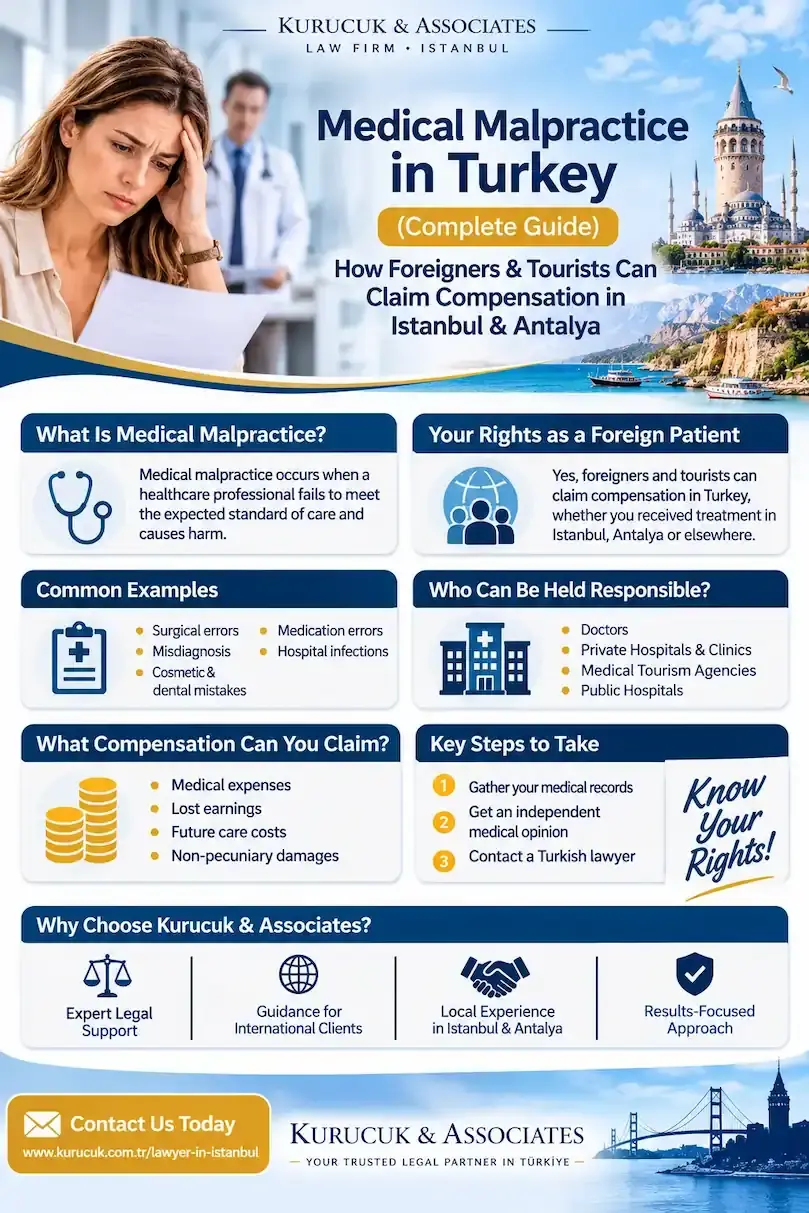
Medical Malpractice in Turkey (Complete Guide): How Foreigners & Tourists Can Claim Compensation in Istanbul & Antalya


Receiving medical treatment in another country requires trust. Patients expect doctors to listen, hospitals to provide appropriate care and medical professionals to explain the risks before recommending a procedure. When that trust is broken by a preventable medical error, the consequences can extend far beyond the original treatment.
For a foreign patient, the situation can become even more difficult. Someone who travels to Istanbul for cosmetic surgery, visits Antalya for dental treatment or requires emergency medical care during a holiday may find themselves dealing with an unexpected injury, additional medical expenses and uncertainty about what to do next.
The questions usually come quickly.
Can I sue a Turkish hospital if something went wrong during surgery? Does Turkish law protect foreign patients? Can I claim compensation after returning to my home country? Is the doctor personally responsible, or should the claim be brought against the hospital? What happens if I signed a consent form before the procedure?
The important point is that foreign patients have legal rights in Türkiye. A person does not have to be a Turkish citizen or permanent resident to pursue a medical malpractice claim arising from treatment in the country. However, establishing liability requires more than showing that a treatment was unsuccessful. The medical evidence, professional standard of care, resulting injury and applicable legal provisions must be examined.
At Kurucuk & Associates, an Istanbul-based Turkish law firm advising international clients, we recognize that these cases often involve several connected issues: medical negligence, patient rights, contractual liability, healthcare regulations, consumer protection and cross-border legal procedures.
1. What Is Medical Malpractice Under Turkish Law?
Medical malpractice, commonly referred to in Türkiye as tıbbi malpraktis or hekim hatası, generally describes a situation in which a healthcare professional or institution fails to meet the applicable standard of medical care and causes harm to a patient.
It may involve an incorrect diagnosis, an avoidable surgical injury, inappropriate medication, inadequate monitoring or a failure to respond properly to a medical complication.
However, there is an important distinction between medical negligence and an unfortunate medical outcome.
Medicine is not an exact science. Even when a doctor acts appropriately, a patient may experience an adverse reaction, an unexpected complication or a result that differs from what was anticipated.
For this reason, Turkish law does not automatically treat every unsuccessful medical procedure as malpractice.
A compensation claim generally requires examination of the following:
Professional or legal failure: Did the doctor or healthcare institution fail to comply with an applicable legal or professional duty?
Actual damage: Did the patient suffer a physical injury, psychological harm or financial loss?
Causation: Is there a legally relevant connection between the alleged failure and the damage?
Liability: Can the doctor, hospital, clinic or another responsible party be held legally accountable?
Article 49 of the Turkish Code of Obligations No. 6098 establishes the general principle of liability for damage caused by an unlawful act. Articles 50–56 address proof of damage, compensation, bodily injury and non-pecuniary damages.
The relevant legislation can be consulted in the Turkish Code of Obligations No. 6098.
For patients considering a claim, understanding these principles is an important first step in assessing whether the circumstances may amount to medical malpractice in Turkey.
1.1 When Does a Medical Complication Become Medical Malpractice?
This is often the most difficult question in a medical negligence dispute.
A complication may occur even when a doctor has followed accepted medical standards. However, the way the complication is anticipated, explained, monitored and managed can also become relevant to liability.
Consider two situations.
A patient undergoes surgery and experiences a recognized adverse reaction despite an appropriate medical assessment, properly performed procedure and suitable postoperative care. The fact that the patient suffered a complication does not, by itself, establish negligence.
Now consider a patient who develops warning signs of a serious infection after surgery. The hospital fails to investigate those symptoms or arrange appropriate treatment, allowing the condition to become significantly worse.
The second situation may raise questions about professional negligence, particularly if timely intervention could have prevented or reduced the injury.
The important distinction is therefore not simply whether something went wrong. It is whether the healthcare provider fulfilled the duties expected in the circumstances.
1.2 Common Examples of Medical Malpractice
Medical negligence can arise in almost every area of healthcare. Some disputes involve an obvious procedural mistake, while others require a detailed medical examination to identify what happened.
A. Surgical Errors
Potential examples include:
Performing surgery on the wrong body part.
Carrying out an inappropriate procedure.
Causing avoidable damage to surrounding organs, nerves or tissues.
Leaving surgical instruments or materials inside the patient's body.
Failing to monitor the patient appropriately after surgery.
Delaying necessary treatment when serious postoperative complications develop.
B. Misdiagnosis and Delayed Diagnosis
A diagnostic error may have serious consequences when a condition is not identified or investigated appropriately.
Examples include:
Failing to recognize signs of a serious infection.
Misinterpreting diagnostic imaging.
Incorrectly diagnosing a medical condition.
Failing to investigate symptoms that reasonably require further examination.
Delaying diagnosis when earlier investigation could have changed the outcome.
Not every incorrect diagnosis amounts to negligence. The patient's symptoms, available information and the medical circumstances at the time must be considered.
C. Anesthesia Errors
Anesthesia-related negligence may involve:
Inadequate preoperative assessment.
Failure to identify relevant medical risks.
Incorrect medication or dosage.
Insufficient monitoring during surgery.
Failure to respond appropriately to an anesthetic emergency.
D. Cosmetic and Plastic Surgery Errors
Türkiye attracts international patients seeking aesthetic and reconstructive procedures. These treatments can involve complex medical decisions and significant expectations.
Potential negligence issues include:
Incorrect surgical technique.
Inadequate assessment before surgery.
Avoidable nerve or tissue damage.
Serious postoperative infections.
Inadequate wound care.
Failure to arrange appropriate follow-up.
Failure to explain material risks before the procedure.
An unsatisfactory cosmetic result alone does not prove malpractice. The actual medical treatment, applicable professional standards and resulting damage must be assessed.
E. Dental Treatment Errors
Dental procedures are another common source of disputes involving international patients.
Examples may include:
Incorrect dental implant placement.
Nerve damage.
Inadequate assessment before implant surgery.
Improper root canal treatment.
Incorrect crowns, veneers or bridges.
Failure to identify an underlying infection.
Inadequate postoperative instructions or follow-up.
F. Medication and Prescription Errors
These may include prescribing an inappropriate medication, administering the wrong dosage, overlooking a known allergy or failing to consider a clinically relevant medication interaction.
G. Hospital-Acquired Infections
A hospital may face liability where an infection is connected to failures in sterilization, hygiene, infection prevention or patient monitoring.
However, an infection developing during hospital treatment does not automatically establish negligence. Its source and the adequacy of the preventive and treatment measures must be investigated.
2. Can Foreigners and Tourists Claim Compensation for Medical Malpractice in Turkey?
Yes. Foreign nationals can pursue compensation claims arising from medical negligence in Türkiye, subject to the applicable legal requirements.
Turkish law does not generally require a person to hold Turkish citizenship or permanent residence simply to bring a claim concerning negligent medical treatment received in the country.
This is relevant to several categories of international patients:
Tourists who receive emergency treatment while visiting Türkiye.
Medical tourists who travel specifically for surgery or another procedure.
Foreigners receiving dental or cosmetic treatment.
International residents living in Istanbul, Antalya or other Turkish cities.
Patients who return home and discover complications after treatment in Türkiye.
The legal position depends on the circumstances of the treatment, not simply the patient's nationality.
2.1 Can a Foreigner Sue a Turkish Hospital Without Living in Turkey?
Yes.
A foreign patient may pursue an appropriate claim even if they live permanently outside Türkiye.
For example, imagine a patient from the United Kingdom who travels to Istanbul for surgery. After returning to London, the patient develops complications and receives further treatment from doctors in the UK.
The patient may need to:
Obtain medical assessments and treatment records in the UK.
Request the complete treatment file from the Turkish hospital.
Preserve invoices, consent forms and communications.
Have the potential liability assessed under Turkish law.
Appoint a Turkish lawyer through an appropriately executed power of attorney, where representation is required.
Pursue the appropriate legal proceedings in Türkiye.
The patient does not necessarily have to remain in Istanbul throughout the process. Whether personal attendance is required will depend on the proceedings and the court's directions.
2.2 What If I Have Already Returned Home After Treatment in Turkey?
Returning home does not automatically end your legal rights.
In fact, many international medical malpractice disputes only become apparent after the patient has left Türkiye.
A patient may initially believe that postoperative discomfort is part of normal recovery. Weeks later, further examinations may reveal an infection, nerve injury or another complication requiring additional treatment.
In such circumstances, the patient should preserve both the original Turkish medical records and the subsequent medical evidence obtained abroad.
The timing of the discovery may also be relevant when assessing limitation periods.
2.3 Does My Nationality Affect the Amount of Compensation?
Nationality does not automatically determine entitlement to compensation.
However, international elements can affect the practical and legal assessment of a claim.
For example, a patient may have employment income in another country, pay for corrective surgery abroad or need to establish future financial losses using foreign documents.
The relevant court may need to consider the evidence, currency conversions, foreign medical records and the applicable legal rules when assessing the claim.
3. Who Is Responsible for Medical Malpractice in Turkey?
One of the first things to establish in a medical negligence case is who actually undertook responsibility for the treatment.
A patient may have dealt with a hospital, a surgeon, a separate anesthetist, a dental clinic and a medical tourism agency.
These parties do not necessarily have identical legal responsibilities.
3.1 Can a Doctor Be Held Personally Responsible?
Yes, a doctor may face civil liability where the relevant legal requirements are established.
For example, a doctor may be responsible for a failure to exercise appropriate professional care, an unsuitable medical intervention or an inadequate response to a foreseeable complication.
The precise legal basis may arise from contractual obligations, tort liability or other applicable professional duties.
3.2 Can a Private Hospital Be Sued for Medical Negligence?
Yes.
A private hospital may face liability arising from its own organizational and contractual responsibilities, as well as responsibility for the conduct of personnel for whom it is legally accountable.
Depending on the facts, issues may include:
Inadequate patient monitoring.
Nursing care deficiencies.
Poor infection-control arrangements.
Inappropriate medical equipment.
Medication administration errors.
Failure to maintain appropriate medical records.
Organizational failures affecting patient safety.
It is important to establish whether the alleged failure arose from the doctor's treatment, the hospital's organization or both.
3.3 Can a Private Clinic or Dental Centre Be Held Liable?
Yes.
A private clinic, dental center or other healthcare facility may be liable for its own legally actionable failures and, where the relevant legal requirements are met, the conduct of professionals for whom it is responsible.
This can be particularly relevant to disputes involving dental implants, hair transplantation, cosmetic procedures and other treatments offered to international patients.
3.4 What Happens When the Treatment Takes Place in a State Hospital?
Medical malpractice claims involving public hospitals generally follow a different legal route.
Article 129(5) of the Turkish Constitution establishes the general principle that compensation claims arising from faults committed by public officials while exercising their duties are directed against the administration, with the administration retaining its right of recourse in the circumstances provided by law.
Consequently, a claim arising from treatment provided as part of a public hospital service may need to be brought against the relevant administration through administrative proceedings.
The Constitution of the Republic of Türkiye provides the constitutional framework.
This distinction matters. A claim involving a private hospital should not automatically be approached in the same way as a claim involving a state hospital.
4. Medical Malpractice in Istanbul: What International Patients Should Know
Istanbul is one of Türkiye's major centers for private healthcare and international medical treatment.
Patients travel to the city for a wide range of procedures, including cosmetic surgery, hair transplantation, dental treatment, orthopedic surgery, fertility treatment, cardiovascular procedures and general surgery.
The international nature of these services can make a medical negligence dispute more complicated than an ordinary domestic claim.
A patient may have communicated with the surgeon through an interpreter, booked treatment through an intermediary, paid a package fee and received postoperative instructions in a language they do not fully understand.
Each part of that arrangement may become relevant when a dispute arises.
4.1 Medical Negligence in Istanbul Private Hospitals
When examining a potential claim against a private hospital in Istanbul, the treatment records and contractual arrangements should be reviewed together.
Relevant documents may include:
Hospital admission and treatment agreements.
Surgical consent forms.
Medical examination reports.
Surgical and anesthesia records.
Diagnostic imaging.
Laboratory results.
Nursing observations.
Discharge instructions.
Invoices and payment confirmations.
Postoperative correspondence.
It is also important to establish whether the doctor was employed by the hospital, worked independently or provided services under another contractual arrangement.
4.2 Medical Tourism Agencies and Treatment Arrangements
Some international patients arrange treatment through a medical tourism company.
The intermediary may organize consultations, accommodation, transfers and communication with the hospital.
However, arranging a medical appointment does not automatically make the agency legally responsible for every medical decision taken by a doctor.
Its own conduct must be examined separately.
For instance, if an intermediary makes misleading representations about a treatment, breaches a contractual undertaking or independently contributes to the patient's loss, its conduct may become legally relevant.
The responsibilities of the doctor, hospital and intermediary should therefore be assessed individually.
5. Medical Malpractice in Antalya: Rights of Foreign Patients and Tourists
Antalya is an important destination for international visitors. Some travel for holidays, others live there for extended periods, and some specifically arrange medical or dental treatment.
A medical injury can arise in any of these situations.
For example:
A tourist may require emergency surgery following an accident.
A visitor may experience complications after dental treatment.
A patient may suffer an infection following cosmetic surgery.
A foreign resident may receive treatment at a private medical facility.
A visitor may discover a serious injury after returning home.
The same general Turkish medical liability framework applies in Antalya as in Istanbul.
There is no separate Antalya compensation law for medical malpractice.
5.1 Can a Tourist Claim Compensation for Medical Negligence During a Holiday?
Yes, provided the legal requirements for liability are established.
A tourist who receives negligent medical treatment during a holiday may have a compensation claim even if the treatment was unrelated to the original reason for visiting Türkiye.
The important issues are the treatment, the alleged failure, the resulting injury and the appropriate legal procedure.
5.2 What If I Received Treatment in Antalya but Now Live Abroad?
A patient may be able to pursue a claim from their home country through appropriate legal representation.
Medical evidence from the patient's current country of residence can be relevant, particularly where further treatment has been necessary.
The Turkish treatment records should be preserved alongside the overseas medical reports.
5.3 Are the Legal Procedures Different in Istanbul and Antalya?
The underlying legal rules are generally the same.
The appropriate court, however, will depend on the defendant, the nature of the legal relationship, territorial jurisdiction and the circumstances of the dispute.
The city where the patient received treatment is an important consideration, but it does not alone determine every aspect of jurisdiction.
6. What Compensation Can You Claim for Medical Malpractice in Turkey?
When medical negligence causes injury, the consequences may involve much more than the cost of the original treatment.
A patient may require corrective surgery, medication, rehabilitation or long-term care.
They may also be unable to work or experience permanent physical and psychological effects.
Turkish law recognizes different categories of compensable damage, depending on the circumstances.
The principal distinction is between material compensation (maddi tazminat) and non-pecuniary compensation (manevi tazminat).
6.1 Material Compensation (Maddi Tazminat)
Material compensation addresses financial losses that can be legally attributed to the injury.
Article 54 of the Turkish Code of Obligations identifies important categories of bodily injury damages.
A. Medical and Corrective Treatment Expenses
Depending on the evidence, recoverable expenses may include:
Emergency treatment.
Hospital admission.
Corrective surgery.
Medication.
Specialist consultations.
Diagnostic examinations.
Rehabilitation.
Physiotherapy.
Necessary follow-up treatment.
For an international patient, this may include reasonable corrective treatment obtained in their home country.
However, the patient must establish the necessity and connection of the expenses to the original injury.
B. Loss of Earnings
If an injury prevents a patient from working, compensation may be available for proven income losses.
For example, a patient who suffers a serious surgical injury in Istanbul may be unable to return to work for several months.
Employment contracts, salary statements, tax records and medical reports may help establish the financial consequences.
C. Loss of Future Earning Capacity
Some injuries have long-term consequences.
A patient may recover physically to some extent but remain unable to perform the same work or earn the same income.
Where the legal requirements are met, the impact on future earning capacity may be considered when assessing compensation.
D. Permanent Disability
A permanent impairment may affect a patient's ability to work, move independently or carry out everyday activities.
The assessment may involve medical findings, disability-related reports, the patient's occupation and the long-term consequences of the injury.
E. Care and Assistance Expenses
Where an injury creates a genuine need for assistance, the associated costs may also be relevant.
These could include professional nursing, personal care, rehabilitation support and necessary mobility equipment.
6.2 Non-Pecuniary Compensation (Manevi Tazminat)
Not all harm can be measured through invoices or salary statements.
A serious medical injury may cause physical suffering, emotional distress, permanent disfigurement or a lasting disruption to ordinary life.
Article 56 of the Turkish Code of Obligations provides a legal basis for non-pecuniary compensation in appropriate bodily injury and death cases.
The court may consider factors such as:
The seriousness of the injury.
The duration and intensity of suffering.
Permanent physical consequences.
Psychological effects.
The impact on ordinary activities.
The overall circumstances of the incident.
There is no single compensation amount applicable to every medical negligence case.
6.3 Compensation Following a Patient's Death
Where medical negligence results in death, eligible family members and other persons entitled under the relevant legal rules may pursue compensation.
Article 53 of the Turkish Code of Obligations addresses damages arising from death, including:
Funeral expenses.
Treatment expenses incurred before death, where recoverable.
Financial losses arising from the death.
Loss of financial support (destekten yoksun kalma tazminatı).
Article 56 may also provide a basis for non-pecuniary compensation for eligible relatives.
The legal entitlement depends on the relationship with the deceased, financial dependency where relevant and the circumstances of the case.
6.4 Is There a Fixed Compensation Amount for Medical Malpractice in Turkey?
No.
Turkish law does not provide one standard compensation figure for every medical negligence claim.
A patient who requires a limited course of additional treatment will have a different claim from someone who suffers permanent disability or loses their ability to work.
The amount must be assessed according to the actual damage, supporting evidence and applicable legal principles.
Be cautious of anyone promising a guaranteed compensation amount before examining the medical records and circumstances.
7. How Do You Prove Medical Malpractice in Turkey?
A patient may strongly believe that a doctor or hospital made a serious mistake. However, a legal claim must be supported by evidence.
Medical negligence disputes often require a detailed examination of what happened before, during and after treatment.
The evidence should help answer three important questions:
What was the healthcare provider expected to do?
What actually happened?
Did the alleged failure cause the patient's injury?
7.1 Obtain Your Complete Medical Records
The patient's medical file is usually one of the most important sources of evidence.
Under Article 16 of the Patient Rights Regulation, patients have the right to examine their health records and obtain copies, personally or through an authorized representative.
The relevant provision can be consulted through the official Patient Rights Regulation.
Ask the hospital or clinic for the available records, including:
Initial examination and patient history.
Diagnosis and treatment plans.
Surgical reports.
Anesthesia records.
Nursing observations.
Medication administration records.
Laboratory findings.
Radiology reports.
Imaging files.
Consent documents.
Discharge summaries.
Follow-up notes.
Where imaging is involved, request the actual image files where available, not only a written interpretation.
7.2 Obtain an Independent Medical Opinion
An independent medical assessment can help determine whether the treatment complied with the relevant professional standard.
Consider a patient who develops a serious infection after surgery.
An appropriate assessment may need to address:
Whether the infection was foreseeable.
Whether appropriate preventive measures were taken.
Whether warning signs were recognized.
Whether treatment was initiated at the appropriate time.
Whether earlier intervention could have prevented or reduced the injury.
The purpose is to understand the medical issues objectively, not simply to obtain another opinion supporting the patient's initial concerns.
7.3 Medical Expert Reports in Turkish Court Proceedings
Turkish courts frequently rely on expert evidence in complex medical disputes.
Depending on the case, an expert assessment may involve relevant medical specialists, university medical departments, the Forensic Medicine Institute (Adli Tıp Kurumu) or other legally appropriate experts.
An expert may be asked to examine whether the treatment complied with accepted medical practice and whether the alleged failure caused the patient's injury.
The expert report is an important part of the evidence, but the court evaluates the case as a whole.
7.4 Preserve Emails, WhatsApp Messages and Other Communications
International patients often communicate with hospitals and medical tourism companies through electronic messages.
These communications may help establish what the patient was told before treatment and what instructions were provided afterwards.
Preserve:
WhatsApp conversations.
Emails.
Appointment confirmations.
Written treatment proposals.
Payment confirmations.
Advertised treatment descriptions.
Postoperative instructions.
Complaints submitted to the provider.
Responses from the doctor, clinic or hospital.
Keep original electronic records wherever possible.
7.5 Photograph Visible Injuries and Complications
Where an injury involves scarring, disfigurement, wounds or visible postoperative complications, dated photographs may provide useful supporting evidence.
Photographs should be considered alongside medical reports and expert assessments rather than used as a substitute for them.
8. Informed Consent: What If You Were Not Properly Informed Before Treatment?
Informed consent is a fundamental part of the patient-provider relationship.
Before a medical intervention, a patient should receive appropriate information about the proposed treatment, its relevant risks, available alternatives and other matters necessary to make an informed decision.
The Patient Rights Regulation (Hasta Hakları Yönetmeliği) provides an important framework.
Articles 15 and 18 address the information that should be provided to patients and the manner in which that information should be communicated. Article 24 addresses consent to medical intervention.
The regulation is available through the Turkish Ministry of Justice legislation database.
8.1 What Information Should a Patient Receive?
Depending on the procedure, the patient should receive appropriate information about:
The nature and purpose of the treatment.
The proposed medical intervention.
Relevant risks and possible complications.
Available diagnostic and treatment alternatives.
The likely benefits of treatment.
Potential consequences of refusing treatment.
Important postoperative requirements.
The information should be understandable to the patient and appropriate to the medical circumstances.
8.2 Is a Signed Consent Form Enough to Protect a Hospital?
Not necessarily.
A signed form is relevant evidence, but it does not automatically establish that the patient received adequate information or that the medical procedure was performed appropriately.
The actual information provided, the circumstances of the consent and the subsequent treatment must be considered.
A patient who has been informed about a recognized complication does not thereby give a healthcare provider unrestricted permission to act negligently.
8.3 What If the Consent Form Was Written in Turkish?
This is particularly important for international patients.
Imagine a foreign patient who signs several documents before surgery but does not understand Turkish.
The legal assessment may need to consider:
Whether the contents were adequately explained.
Whether an interpreter was provided where necessary.
Whether material risks were communicated.
Whether the patient had an opportunity to ask questions.
Whether the document accurately reflects the consent process.
A Turkish-language consent form is not automatically invalid simply because the patient is foreign. Equally, signing a document does not automatically establish informed consent where the actual information provided was inadequate.
Language barriers can therefore become an important issue in medical malpractice proceedings.
9. Medical Tourism in Turkey: Legal Rights of International Patients
Türkiye has a regulatory framework specifically addressing international health tourism and tourist health.
This is particularly relevant to foreign patients who travel to the country specifically to receive medical treatment.
The Regulation on International Health Tourism and Tourist Health was published in the Official Gazette on 26 April 2025, issue No. 32882.
The regulation addresses the authorization and operation of healthcare providers and intermediary organizations involved in international health tourism.
The Ministry of Health's Health Tourism Department provides access to the relevant regulatory information.
9.1 Are Medical Tourism Hospitals and Agencies Required to Be Authorized?
Healthcare facilities and intermediary organizations operating within the regulated international health tourism framework must comply with the applicable authorization and operational requirements.
The regulatory framework addresses matters including:
Healthcare facility authorization.
Intermediary organization authorization.
Service standards.
Patient information.
Healthcare delivery.
Supervision and inspection.
Foreign patients can consult the official HealthTürkiye platform for information about the country's international health tourism system and relevant certified healthcare providers.
It is sensible to check the status of a provider before arranging treatment.
9.2 Does Authorization Guarantee That Medical Negligence Cannot Occur?
No.
Authorization indicates that a provider is operating within the applicable regulatory framework. It does not guarantee that every medical procedure will be performed without error.
Similarly, a medical complication does not automatically establish a regulatory violation or civil liability.
The actual treatment and the healthcare provider's conduct must still be examined.
9.3 Can a Medical Tourism Agency Be Responsible for a Patient's Injury?
Potentially, depending on its own role and conduct.
For example, an agency may undertake contractual responsibilities concerning treatment arrangements, patient communication or other services.
If it independently breaches those obligations or makes misleading representations that cause legally recognizable damage, it may face a separate claim.
However, an intermediary is not automatically responsible for every clinical decision made by a doctor or hospital.
The relationship between the patient, intermediary and healthcare provider should be examined carefully.
10. Which Court Handles Medical Malpractice Claims in Turkey?
Choosing the correct legal route is essential.
A claim involving a private hospital may follow a different procedure from one arising from treatment at a public hospital.
The appropriate court depends on the identity of the healthcare provider and the legal relationship between the parties.
10.1 Claims Against Private Hospitals
Where the treatment relationship qualifies as a consumer transaction, a medical malpractice dispute may fall within the jurisdiction of the consumer courts (Tüketici Mahkemeleri).
Law No. 6502 on Consumer Protection provides the relevant statutory framework.
However, not every dispute involving a doctor or healthcare provider automatically qualifies as a consumer dispute.
The legal relationship, contractual arrangements and nature of the service must be examined.
The Consumer Protection Law No. 6502 is an important reference when assessing private healthcare claims.
Mandatory Mediation in Consumer Disputes
Article 73/A of Law No. 6502 provides for mandatory mediation in certain consumer disputes before court proceedings.
There are statutory exceptions, and the requirement depends on the nature of the claim.
It is therefore important to establish whether mediation is required before commencing proceedings.
10.2 Claims Against Independent Doctors
Where treatment is provided by an independent medical practitioner, the legal basis may involve contractual liability, tort liability or other applicable professional duties.
The competent court depends on the circumstances and the nature of the relationship.
A claim should not be classified solely according to the professional title of the defendant.
10.3 Medical Malpractice Claims Against Public Hospitals
Claims arising from medical services provided by public hospitals generally follow the administrative law route.
A full-remedy action (tam yargı davası) may need to be brought before the competent administrative court.
Article 13 of the Administrative Procedure Law No. 2577 generally requires an application to the relevant administration before filing the action.
The Administrative Procedure Law No. 2577 provides the relevant procedural framework.
This distinction should be addressed at the beginning of a case, rather than after proceedings have already been initiated.
11. How Long Do You Have to File a Medical Malpractice Claim in Turkey?
Limitation periods are particularly important in medical negligence disputes.
A patient should not assume that the time limit begins when they first contact a lawyer or receive a final medical report.
The applicable period depends on the legal basis of the claim.
11.1 General Tort Claims: Article 72
Under Article 72 of the Turkish Code of Obligations, compensation claims arising from tort are generally subject to:
A two-year period from the date the injured person becomes aware of the damage and the person responsible.
An absolute ten-year period from the date the act occurred.
Where the act also constitutes an offence carrying a longer criminal limitation period, the longer period may apply in the circumstances provided by law.
These rules are particularly relevant to claims based on tort liability.
11.2 Contractual Medical Malpractice Claims
Where a claim arises from a contractual relationship, different limitation provisions may apply.
For example, Article 147 of the Turkish Code of Obligations establishes a five-year limitation period for certain specified claims, including certain claims arising from agency and mandate relationships.
Other contractual relationships may be governed by different provisions.
The legal classification of the treatment agreement is therefore important.
It would be misleading to tell every patient that all medical malpractice claims in Türkiye have the same two-year or ten-year limitation period.
11.3 Public Hospital Claims: One-Year and Five-Year Periods
Claims arising from administrative actions or conduct may be subject to Article 13 of Law No. 2577.
Under this provision, an injured person generally must apply to the relevant administration:
Within one year of learning of the relevant administrative action or conduct and the resulting infringement.
In any event, within five years of the relevant action or conduct.
Where the administration rejects the application, or does not respond within the statutory thirty-day period, the subsequent administrative court filing period must be calculated under the applicable procedural rules.
As a general rule, the administrative litigation period is sixty days, subject to the statutory provisions and the particular circumstances.
11.4 What If You Discover the Injury Months After Surgery?
This situation is common in international medical treatment.
A patient may undergo surgery in Istanbul, return home and only later discover the full extent of an injury.
The following dates may become relevant:
Date of the procedure.
Date the injury first became apparent.
Date the patient became aware of the damage.
Date the responsible party became identifiable.
Dates of subsequent medical assessments.
The legal starting point cannot be determined solely by the date of the final expert report.
The complete circumstances should be assessed before concluding that a claim is within or outside the limitation period.
11.5 Does a Criminal Investigation Extend the Compensation Limitation Period?
In certain circumstances, a longer criminal limitation period may be relevant under Article 72 of the Turkish Code of Obligations.
However, this is not an automatic extension for every medical malpractice dispute.
The alleged conduct, the relevant criminal offence and its applicable limitation period must be examined.
Practical point: Do not delay legal advice while waiting for every aspect of an injury to become clear. Limitation periods should be checked as early as possible.
12. Can You File a Criminal Complaint Against a Doctor in Turkey?
Yes, where the circumstances may constitute a criminal offence.
Civil compensation proceedings and criminal proceedings are separate legal processes.
A patient may have grounds for a civil claim without the conduct necessarily amounting to a criminal offence. Equally, a criminal investigation does not automatically establish the amount of civil compensation payable.
Depending on the facts, the relevant provisions of the Turkish Penal Code No. 5237 may include:
Article 89: Negligent injury (taksirle yaralama).
Article 85: Causing death by negligence (taksirle öldürme).
A complaint may lead to an investigation by the competent public prosecutor.
The investigation may involve medical records, witness statements, expert assessments and an examination of the alleged professional failure.
12.1 Does a Criminal Complaint Automatically Result in Compensation?
No.
A criminal complaint is not a substitute for pursuing the appropriate civil or administrative compensation claim.
The patient's right to seek compensation must be assessed separately.
12.2 Can a Foreigner File a Criminal Complaint From Abroad?
A foreign patient may be able to pursue a matter through legally recognized representation and the appropriate procedural channels.
The precise procedure depends on the circumstances and the applicable criminal procedural requirements.
The complaint should be supported by a clear account of the treatment, the alleged error, the resulting injury and the available medical evidence.
13. What Documents Do You Need for a Medical Malpractice Claim in Turkey?
A well-organized evidence file can make a significant difference to the assessment of a medical negligence dispute.
The exact documents depend on the procedure and injury, but the following are commonly relevant.
13.1 Medical Documents
Hospital admission records.
Initial examination reports.
Medical history.
Diagnosis and treatment plans.
Surgical and anesthesia reports.
Consent forms.
Laboratory findings.
Radiology reports and imaging files.
Discharge summaries.
Postoperative records.
Independent medical opinions.
13.2 Financial Documents
Hospital invoices.
Payment receipts.
Medication expenses.
Corrective treatment invoices.
Relevant travel and accommodation expenses.
Employment contracts.
Salary statements.
Tax records.
Evidence of lost earnings.
Other documents establishing financial loss.
13.3 Identity and Legal Documents
Passport or identity document.
Contact information.
Treatment agreement, if available.
Power of attorney, where representation is required.
Relevant correspondence.
Documents establishing family relationships in fatal cases.
13.4 Medical Records Issued Outside Türkiye
Foreign medical records can be important when the patient continues treatment in their home country.
Depending on the document and the intended legal use, an apostille, legalization or certified translation may be required.
Türkiye is a party to the Hague Apostille Convention.
The Hague Conference on Private International Law provides information about the Convention and participating authorities.
An apostille authenticates the origin of a public document. It does not certify the medical accuracy of the information contained in it.
14. How to Claim Medical Malpractice Compensation in Turkey: Step-by-Step
Although no two cases are identical, the following stages provide a practical overview of the process.
Step 1: Address Your Medical Needs First
If complications develop, obtaining appropriate medical care should be the immediate priority.
Do not delay necessary treatment while trying to collect evidence or resolve a disagreement with the original hospital.
Where appropriate, obtain an independent medical assessment.
Step 2: Request the Complete Medical File
Contact the hospital or clinic and request copies of the treatment records.
Preserve the original documents, imaging files, invoices and written communications.
If you have returned home, keep records of subsequent medical treatment as well.
Step 3: Identify the Healthcare Provider and Other Relevant Parties
Establish whether the treatment was provided by a private hospital, state hospital, independent doctor, dental center or another healthcare facility.
Identify any medical tourism intermediary involved in arranging the treatment.
This information helps determine the potentially responsible parties and applicable legal procedure.
Step 4: Arrange a Medical and Legal Assessment
The alleged medical error should be examined against the relevant professional standards.
The legal assessment should then address:
Potential liability.
The correct defendant.
Available evidence.
The connection between the alleged failure and the injury.
Possible compensation categories.
Limitation periods.
Appropriate court jurisdiction.
Step 5: Consider a Formal Notice or Settlement
Depending on the case, it may be appropriate to send a formal notice to the healthcare provider.
Some disputes can be resolved through negotiation.
However, a patient should not sign a settlement, waiver or release without understanding its legal consequences.
Step 6: Complete Mandatory Mediation Where Required
If the dispute falls within a category requiring mandatory mediation, the applicable mediation procedure must be completed before the relevant court proceedings.
Not every medical malpractice claim follows the same mediation requirements.
Step 7: File the Appropriate Legal Claim
Depending on the legal relationship and healthcare provider, proceedings may be brought before a consumer court, civil court or administrative court.
The claim should clearly identify the alleged failure, responsible parties, damage and supporting legal grounds.
Step 8: Participate in Medical Expert Assessment
The court may request expert reports or additional medical evidence.
The patient's legal representative may need to address the expert's findings and identify any issues requiring further examination.
Step 9: Obtain and Enforce the Final Decision
If the court finds liability, it may award compensation in accordance with the evidence and applicable law.
If the defendant does not comply voluntarily, enforcement proceedings may be required.
For an international patient, enforcement in another country may involve additional recognition and enforcement requirements.
15. Can You Claim Compensation After Cosmetic Surgery in Turkey?
Cosmetic surgery is an important area of medical malpractice law because many international patients travel to Türkiye specifically for aesthetic procedures.
Common treatments include:
Rhinoplasty.
Facelift surgery.
Liposuction.
Breast augmentation.
Breast reduction.
Tummy tuck surgery.
Eyelid surgery.
Hair transplantation.
Other aesthetic and reconstructive procedures.
15.1 Is a Poor Cosmetic Result Enough to Establish Negligence?
Not necessarily.
A patient may be disappointed with the appearance following surgery, but dissatisfaction alone does not establish medical malpractice.
The assessment may need to consider:
Whether the procedure was appropriate.
Whether the doctor followed the applicable professional standard.
Whether the risks were adequately explained.
Whether the surgery was performed properly.
Whether appropriate postoperative care was provided.
Whether an avoidable injury occurred.
15.2 What If Surgery Causes Permanent Scarring or Disfigurement?
Permanent scarring, disfigurement or functional impairment may support a compensation claim if the relevant legal requirements are established.
The assessment may include financial losses, additional treatment costs and non-pecuniary damage.
Medical reports, dated photographs and evidence of the long-term consequences can be important.
15.3 What If You Need Corrective Surgery in Your Home Country?
A patient who undergoes corrective surgery abroad may be able to include reasonable and legally recoverable expenses in a Turkish compensation claim.
The patient should retain medical reports explaining why the corrective procedure was necessary and how it relates to the original treatment.
The court will need to assess the medical necessity, causal connection and recoverability of the claimed expenses.
16. Can You Claim Compensation for Dental Malpractice in Turkey?
Dental treatment is another area in which international patients may encounter unexpected complications.
People travel to Istanbul and Antalya for dental implants, veneers, crowns, bridges, restorative treatment and other procedures.
Problems may become apparent during treatment or after the patient returns home.
16.1 Common Dental Negligence Issues
Potential issues include:
Improper implant positioning.
Nerve damage.
Failure to assess the patient's dental condition adequately.
Inadequate infection control.
Incorrect dental restorations.
Failure to identify an underlying infection.
Inadequate postoperative care.
16.2 What Evidence Is Important?
Relevant evidence may include:
Dental treatment plans.
Panoramic X-rays.
CBCT scans.
Implant records.
Surgical notes.
Consent forms.
Invoices.
Follow-up reports.
Independent dental assessments.
Where corrective treatment is provided abroad, the new dentist's findings may help explain the nature and progression of the problem.
16.3 Can a Dental Clinic Be Required to Pay for Corrective Treatment?
Potentially, where the applicable legal requirements are established.
The court must examine whether the dentist or clinic breached a relevant professional or legal duty and whether that failure caused compensable damage.
The amount will depend on the medical evidence and the losses that can legally be recovered.
17. What If You Signed a Medical Treatment Agreement or Waiver?
International patients are sometimes asked to sign several documents before receiving treatment.
These may include treatment agreements, consent forms, declarations about medical risks and provisions addressing complications or refunds.
However, signing an agreement does not automatically remove every legal right.
The enforceability of a particular provision depends on the applicable law, the nature of the obligation and any mandatory statutory protections.
A legal review may need to examine:
The wording of the agreement.
The identity of the contracting parties.
The applicable law.
The information provided before treatment.
Whether the relevant provision is enforceable.
Whether consumer protection legislation applies.
For example, a general statement that a hospital accepts no responsibility for any possible complication should not automatically be treated as immunity from liability for negligent treatment.
Patients should obtain legal advice before signing a settlement or release that may affect future compensation rights.
18. What If the Hospital Offers a Refund Instead of Compensation?
A hospital or clinic may offer a refund, complimentary treatment or another settlement after receiving a complaint.
Before accepting, it is important to understand what the offer actually covers.
Returning the price of a procedure does not necessarily compensate a patient for permanent nerve damage, corrective surgery, lost earnings or other legally recoverable losses.
Consider the following questions:
Does the offer cover the full cost of additional treatment?
Has the long-term medical position been established?
Is corrective surgery likely to be necessary?
Does the agreement waive further legal claims?
Does accepting the payment affect any existing proceedings?
A settlement should be considered in light of the actual injury, not simply the original treatment price.
19. Medical Malpractice Claims and Foreign Insurance Companies
International patients may have private health insurance, travel insurance or another form of medical coverage.
The existence of insurance does not automatically prevent a claim against a legally responsible healthcare provider.
However, the insurance policy should be reviewed separately.
Relevant questions may include:
Does the policy cover medical complications abroad?
Does it cover emergency treatment?
Are corrective procedures included?
Are elective cosmetic treatments excluded?
Are there notification requirements?
Does the insurer have subrogation or recovery rights?
The patient's rights against the healthcare provider and contractual rights against an insurer are separate legal questions.
Any insurance payments and potential recovery rights may also need to be considered when calculating the claim.
20. Can a Turkish Medical Malpractice Judgment Be Enforced Abroad?
A foreign patient may obtain a judgment in Türkiye but wish to pursue enforcement against assets located in another country.
Whether this is possible depends on the legal framework in the country where enforcement is sought.
Relevant considerations may include:
Applicable international conventions.
Bilateral agreements.
Domestic recognition and enforcement rules.
Whether the Turkish judgment is final.
Jurisdictional requirements.
The nature of the judgment.
Any applicable procedural restrictions.
For example, a Turkish compensation judgment intended to be enforced in the United Kingdom may need to satisfy the relevant UK recognition and enforcement requirements.
A Turkish judgment should not be assumed to be automatically enforceable in every country.
This issue is worth considering early, particularly where the defendant or relevant assets are located outside Türkiye.
21. Why Legal Representation Matters in International Medical Malpractice Cases
A medical negligence dispute involving a foreign patient is rarely just a question of whether the doctor made a mistake.
The case may involve several connected areas of Turkish law:
Medical professional liability.
Contractual obligations.
Consumer protection.
Administrative liability.
Healthcare and medical tourism regulations.
Civil procedure.
Criminal procedure, where relevant.
Limitation periods.
Foreign-language evidence.
International document authentication.
Recognition and enforcement of judgments.
The appropriate legal strategy depends on how these issues interact.
21.1 Understanding Turkish Medical Records and Foreign Documents
International cases may involve records issued in Turkish, English or another language.
The relevant documents may need certified translation or other formalities before being used in legal proceedings.
Foreign medical reports can also require authentication, depending on their origin and intended use.
21.2 Identifying the Correct Defendant
The doctor, hospital and medical tourism intermediary may have different responsibilities.
A claim against the wrong party or under an unsuitable legal basis can create avoidable procedural difficulties.
The contractual and factual relationships should be reviewed before proceedings are initiated.
21.3 Protecting Your Position During Settlement Discussions
Patients may receive a refund offer, an invitation for corrective treatment or a document asking them to confirm that they have no further complaints.
It is important to understand the legal consequences before accepting such an offer.
Independent legal advice can help patients assess whether a proposed settlement adequately addresses their losses and whether it affects their ability to pursue further claims.
22. How Kurucuk & Associates Can Assist With Medical Malpractice Matters in Turkey
Kurucuk & Associates is an Istanbul-based Turkish law firm advising international individuals, investors, businesses and clients dealing with legal matters in Türkiye.
Medical malpractice disputes involving foreign patients require a careful understanding of the treatment relationship, the applicable Turkish legislation and the evidence available.
Our approach focuses on examining the circumstances of the dispute before determining the appropriate legal route.
Depending on the nature of the matter, legal assistance may involve:
Preliminary legal assessment of medical negligence allegations.
Examination of private hospital and clinic treatment agreements.
Assessment of potential claims against doctors and healthcare institutions.
Review of medical tourism intermediary arrangements.
Legal analysis of informed consent and patient information obligations.
Assessment of material and non-pecuniary compensation.
Identification of the appropriate court and procedural route.
Review of Turkish and foreign medical documentation.
Assistance with legal representation for international patients.
Assessment of settlement proposals and enforcement considerations.
Our Istanbul office provides a Turkish legal point of contact for international clients whose treatment or related legal dispute arose in Türkiye.
For patients who received treatment in Antalya or another Turkish city, the relevant legal position can be assessed according to the healthcare provider, treatment arrangements and applicable procedural rules.
22.1 A Careful Legal Assessment Before Starting a Claim
Not every unsuccessful treatment will support a successful compensation claim.
A responsible assessment should consider both the patient's concerns and the available medical evidence.
The purpose is to establish whether a legally sustainable claim may exist, which parties could be responsible, what additional evidence is required and which procedure should be followed.
This is particularly important for international patients who may be coordinating the matter from another country.
22.2 Meet Our Legal Team
International clients dealing with Turkish legal matters can learn more about the lawyers at Kurucuk & Associates.
Our lawyers advise on a range of Turkish legal matters involving foreign individuals, businesses and international transactions.
22.3 Contact Kurucuk & Associates
If you or a family member experienced a possible medical error during treatment in Istanbul, Antalya or elsewhere in Türkiye, the circumstances can be submitted for an initial legal assessment.
Patients living abroad can also enquire about the possibility of arranging representation without remaining in Türkiye.
To discuss a potential medical malpractice matter, visit our Istanbul law firm contact page.
You may wish to have the treatment date, healthcare provider's details, available medical records and a brief account of what happened ready when making an enquiry.
23. Frequently Asked Questions About Medical Malpractice in Turkey
1. Can a foreigner sue a hospital in Turkey for medical malpractice?
Yes. Foreign nationals can pursue compensation claims arising from medical negligence in Türkiye, provided the applicable legal requirements are established. Turkish citizenship or permanent residence is not generally required simply to bring such a claim.
2. Can tourists claim compensation for medical negligence in Istanbul?
Yes. Tourists who suffer injury as a result of legally actionable medical negligence in Istanbul may pursue an appropriate claim. The legal procedure depends on whether treatment was provided by a private or public healthcare institution and the nature of the treatment relationship.
3. Can I sue a Turkish hospital after returning to my home country?
Yes. Returning home does not automatically prevent a claim. Depending on the proceedings, a patient may be able to pursue the matter through a properly appointed Turkish legal representative and use relevant medical evidence obtained abroad.
4. Can I sue a private hospital in Turkey for a surgical error?
Potentially. A private hospital may face liability for its own failures and, where the legal requirements are met, conduct for which it is legally responsible. The patient must establish the relevant legal basis, damage and causal connection.
5. Is a doctor personally liable for medical malpractice in Turkey?
A doctor may face personal civil liability depending on the circumstances and legal relationship. However, treatment provided by public officials in the exercise of official duties generally follows the applicable administrative liability framework.
6. Can I claim compensation for failed cosmetic surgery in Turkey?
Yes, if legally actionable negligence and resulting damage can be established. An unsatisfactory cosmetic result alone is not sufficient. The procedure, professional standards, informed consent and actual injury must be examined.
7. Can I claim compensation for dental implant complications in Turkey?
Potentially. If the complication results from an established professional error or another legally actionable failure, a patient may pursue compensation for qualifying financial and non-financial losses.
8. What if I was not informed about the risks of surgery?
Inadequate informed consent may be legally relevant. Turkish patient rights legislation recognizes the patient's right to information and consent. Whether a failure supports compensation depends on the circumstances and its legal consequences.
9. Can I claim compensation if I develop an infection after surgery?
Potentially. A healthcare provider may face liability if an infection is attributable to a failure in infection prevention, sterilization, monitoring or other relevant duties. The presence of an infection alone does not establish negligence.
10. How much compensation can I receive for medical malpractice in Turkey?
There is no fixed amount. Compensation depends on the seriousness of the injury, treatment expenses, lost income, permanent impairment, future financial consequences and legally recoverable non-pecuniary damage.
11. What is the limitation period for medical malpractice claims in Turkey?
It depends on the legal basis. General tort claims are ordinarily subject to the two-year knowledge period and ten-year maximum under Article 72 of the Turkish Code of Obligations, subject to the longer criminal limitation rule where applicable. Contractual claims and public hospital claims may follow different limitation rules.
12. What is the time limit for claiming against a public hospital in Turkey?
Under Article 13 of Law No. 2577, an application to the relevant administration is generally required within one year of learning of the relevant conduct and resulting infringement, and in any event within five years of the conduct. The subsequent court filing period must be calculated under the applicable administrative procedure rules.
13. Can I file a criminal complaint against a doctor in Turkey?
Yes, where the circumstances may constitute a criminal offence. Depending on the facts, negligent injury under Article 89 or negligent homicide under Article 85 of the Turkish Penal Code may be relevant. Criminal proceedings and compensation claims are separate legal matters.
14. Can I sue a medical tourism agency in Turkey?
Potentially. An intermediary may face liability for its own contractual breaches, misleading representations or other legally actionable conduct. It is not automatically responsible for every medical error committed by an independent doctor or hospital.
15. Does signing a consent form prevent me from claiming compensation?
No, not automatically. A signed consent form does not give a healthcare provider unrestricted immunity from liability. Its contents, the information provided and the circumstances of treatment must be examined.
16. Can medical expenses paid in another country be included in a Turkish compensation claim?
Potentially. Reasonable and legally recoverable expenses for corrective treatment abroad may form part of a claim if their necessity and connection to the original medical injury are established.
17. Do I need to travel to Istanbul to file a medical malpractice claim?
Not necessarily. Depending on the proceedings, legal representation may be possible through a properly executed power of attorney. Personal attendance may nevertheless be required in particular circumstances or where directed by the court.
18. Are medical malpractice laws different in Istanbul and Antalya?
The underlying Turkish legal framework is generally the same. The competent court and procedure depend on the healthcare provider, legal relationship and circumstances rather than a separate city-specific malpractice law.
19. Can family members claim compensation if a patient dies because of medical negligence?
Yes, where the legal requirements are satisfied. Articles 53 and 56 of the Turkish Code of Obligations provide relevant frameworks for financial losses arising from death and non-pecuniary compensation for eligible relatives.
20. Can I claim compensation if the hospital offers a refund?
Potentially. A refund does not necessarily cover medical expenses, lost earnings, permanent injury or other legally recoverable damage. Any proposed settlement or release should be reviewed before acceptance.
21. Can I make a medical malpractice claim if I signed a Turkish-language agreement that I did not understand?
The language of the agreement may be relevant when examining whether the patient received adequate information and gave informed consent. Signing a document does not automatically establish that every legal requirement was satisfied.
22. Can I claim compensation for permanent nerve damage after dental treatment in Turkey?
Potentially. The medical evidence must establish the nature of the injury, whether the applicable professional standard was breached and whether the alleged failure caused the damage. Corrective treatment expenses and other qualifying losses may also be considered.
23. Can I claim compensation for a medical error that happened several years ago?
Possibly, depending on the applicable limitation period and the circumstances. Contractual, tort and public hospital claims may follow different rules. The relevant dates should be assessed before concluding that a claim is time-barred.
24. Can I claim compensation if the doctor explained that complications were possible?
Yes, potentially. Being informed about a recognized medical risk does not automatically remove liability for negligent treatment or inadequate management of a complication. The actual circumstances must be examined.
Protecting Your Rights After Medical Negligence in Turkey
An unexpected medical injury can be difficult to deal with, particularly when the treatment took place in another country.
A patient may have to arrange further treatment, deal with additional expenses and understand a legal system that operates in a different language.
However, foreign nationality and returning home do not automatically prevent a person from pursuing a medical malpractice claim in Türkiye.
The important first step is to understand what happened and preserve the evidence. The medical records, consent process, treatment agreement and subsequent medical assessments can all help establish whether the healthcare provider fulfilled the relevant legal and professional duties.
It is equally important to identify the correct legal route. Claims involving private hospitals and independent practitioners may differ from those involving public hospitals, and limitation periods should never be assumed to be identical.
For international patients, an early legal assessment can help clarify potential liability, available compensation and the procedural steps required under Turkish law.
Kurucuk & Associates, an Istanbul-based Turkish law firm, advises international clients on legal matters arising in Türkiye. Where a medical treatment dispute involves Istanbul, Antalya or another Turkish city, the relevant legal position can be examined in light of the individual circumstances.
Understanding your rights is an important first step towards deciding what to do next.
Legal Information and Important Notice
This article provides general information about medical malpractice and compensation under Turkish law. It does not constitute legal advice or establish that a particular healthcare provider is liable.
Medical liability, court jurisdiction, compensation and limitation periods depend on the applicable legislation and the specific circumstances of each case. The Turkish-language statutory text and its amendments prevail where an English translation differs.
Legal Review
This article has been reviewed by Zeynep Atım Kurucuk, Attorney at Law, registered with the Istanbul Bar Association (Bar Registration No. 35415), to support its legal accuracy and provide readers with reliable information on medical malpractice claims in Türkiye.


